
[F]or laymen we breathe through the lungs. Descartes said that{} air gets pulled into the lungs, and is absorbed into the blood, and the blood carries it to the rest of the body. That's what he felt the blood vessels were doing, just by doing anatomy. That was [in the] 1600[s] and was in Discourse on the Method. Really, what he was trying to get at, too, the whole "I think therefore I am" thing was the starting point. Which, that's the kind of logic we need to use again, as it gets us further than having to rigidly define everything, and pick at hyper technicalities. The principle is true, but the particulars are a little bit different. We need the principles, to move to the particulars, not the particulars to move to the principles. That's the basic categorical fallacy everyone's making in academia, and is causing us to lose everything we know.

I can think of scholars who disregard Papias' fragment, when half a dozen fragments say Papias knew St. John. And there, we have two fragments of a corroborated chain linking two Gospels to witnesses, and a first century saint who knew other witnesses, or heard from those who knew witnesses: and another two fragments, that say Papias dictated the book from John, corroborating again, another chain of witness. It's an important part of scholarship to move to the principle and not nullify the facts.

Between two numbers are infinite points, so if we focus on the infinite gap between Being, we never arrive at it. Which is the fundamental flaw of Western Philosophy, is to remove essence from the equation, which essentially removes body from the world, and breaks down all logical chains.

Also, consider, "Antichrist" is disembodied, so that there is no body. There can be no statement "Jesus Christ is Come in the Flesh", for to Antichrist, all is incorporeal and built through magic. It is sustained through his will, and not God's. As is the Gnostic belief of the Body and Soul being dualisms, and the Body was evil but the Soul was good. This is not the way we understand it, if we're going to have science. The body and soul are good, and are inseparable from one another. What happens to the body, is experienced by the soul, and vice versa. What is the body, but isn't the soul is not whole, nor is what is the soul, but not the body. For the Body without a Soul or the Soul without a Body is but a demonic apparition, and ceases to be. It is to be doubleminded, and therefore, at variance from the established Word of God. Therefore, to be nothing, and the Atheist Philosophers preach this doctrine, which how can there be any being or existence without God? That is the question... and Philosophers have never answered it, and likely could not. Or else they would have.
Category: Analysis
Analysis of Athos from The Three Muskateers
It is interesting, that in the modern moment, I suspected Athos of being queer. But, recall, that's a modern lens, and not truly who Athos is. It wouldn't have even dawned on the author to make a character like that. Where there is mystery, and disinterest in women, isn't necessarily because of Athos being Gay, but from having loved deeply, and having to put his wife to death. Even so, they didn't even have sex, having been married. Athos never saw the Fleur-De-Lis brand on her shoulder. The culture, at that time, was disinterested in sex. It was not something they really thought about, as is evident in the story that people would be married, and not even have seen their wife's nudity. And certainly, men wouldn't sleep with other men, they would have no conception of it.
Self Assessment
2022

IQ... 157

Myers Briggs... INFP Though I want to be an INFJ, I am not conscientious enough.

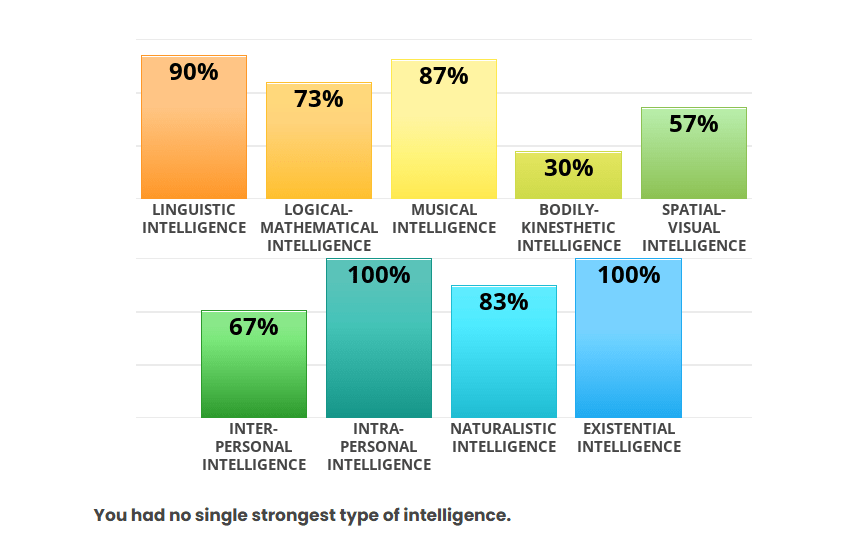
Multiple Intelligences

Verbal... 100%
Mathematical... 57%
Musical... 77%
Kinesthetic... 23%
Spatial Visual... 73%
Interpersonal... 90%
Intrapersonal... 100%
Naturalistic... 90%
Existential... 100%

Big 5 Personality

45% on Extroversion
67% on Emotional Stability
80% on Agreeableness
12% on Conscientiousness
96% in Intellect and Imagination

Update December 2025:

My Intrapersonal intelligence is 100. My Naturalistic intelligence is 97. But, my Musical intelligence is the third highest, at 70. My English is 67. My Logical is 67. My Spatial intelligence is 67. My Interpersonal is 40. My Kinesthetic is 43.

August 2026
On Friendship
On Friendship

I will speak short about real friendship. Not the exalted feeling, or a hyperbole. Not the kind mixed with infatuation, or the kind that burns hot.

Real friendship is born from an immediate spark. There is a sense, as soon as you meet this person, that they are important, and will be in your life for a very long time. There is a shared activity, be it bonding over child's play, or a love for math, or a love for science, or a love for philosophy. And receiving this impression, one uniquely bonds over this shared activity.

If it is a spouse, a wife or husband, make sure this activity is not physical. But, the same applies to a mate, you must immediately impress upon yourself the importance and gravity of this person.

And then understand, there will be fights. There will be war among you sometimes. There will be disappointments. There will be calculations, there will be cunning victories won on battlefields of the mind. But, there will also be sweet moments of tender reconciliation.

As, the friend is there for a lifetime. Not merely for a moment. And if you have two or three of them, you have done well and lived well. If this person is your mate, or spouse, then you have won the gift and treasure of life.

And you will separate at times, being hot and cold toward one another. There will be thoughts of deception, of some great competition with this person. That you must best them at a sport you do not quite understand. But, then you separate, and reconcile, and the friendship is renewed.

The friend knows you, so when you change slightly, or are different, they will know your soul, therefore it will not impress upon them that you are a different kind of person, but are the same friend they always knew, with a new perspective on life. You will have changing perspectives, and challenges with this person, and respect them. The friend knows you, and you know them, so when they change, you respect them, and see the person you always knew. Not merely the veneer of opinions and tastes, but rather the soul  you were knit with.

It is a rare thing, to find a friend. And sometimes, a friend will separate from you for a short season, and then reunite with you. And you will be honest toward them, and they you, and the nighttime is over, and the sweet conciliation is met with affection.

For a friend doesn't leave you. Years worth of not speaking, opinions changing like the winds and seasons, you still will see the person they always were, and always have been. And there is your friend. Keep at peace with them, and do not forsake them.
On Faith and Math
[There's enough evidence for the Bible to know it's true.] You know, in Calculus, you have enough information to find the answer. If you needed all of it, you'd just keep adding up the sums forever. Sometimes, you have to see the pattern, and [divide] to the right answer.

{}Numbers are not abstractions. They're measurements. And the reason Calculus works, is that the measurements in an infinite series, increase, and it gets calculated out to infinity in what's called a limit. But, you only need one or two ratios to get to the answer, not the entire infinite sum.

Same thing with this, I don't need all the evidence to know the Bible's true. Only enough to complete the pattern.

To get a good idea of it, look at [an infinite sum.] It's just seeing the pattern, you can jump the the conclusion, without all of [the ratios] being used.

And calculus basically takes that same idea, and uses it with trigonometry and formulas which are comprised of different curves through what's called a derivative, to basically do the same thing, and calculate a curve, or the area underneath it.

But generally, a lot of things in life have to be a leap of faith. You can't scratch at all the data, you have to make an assumption, even though it is 100% true.

[Two] looks like a lot of things. {}

I mean, I'm not going to go over number theory{} [it] should have [been] learned {} in third grade. {}[D]oes the word "Dandelion" exist? You know? Or "Atom"[?] That's just semantics. And really a rabbit hole for navel gazers. The fact is, there's a thing, we talk about it, and that's how most things work in the real world.

{}I'm making an analogy between calculus and evidence for the Bible. [It's] asked [of] me, "Do you know all the evidence for the Bible?" I sa[y], "No, but you don't have to, because like in calculus, you can make a leap to the conclusion, with limited information." Then [it's] retorted, "Math is an abstraction." [Then I say] it's not. And then [it's] said, "Show me two."

You see, [this is] mining down to the very basics of ontology. [It's] asking a question irrelevant to the point, of what is a number, when I simply said, you can reason to higher things, with limited knowledge. So, likewise, with numbers, we know what they are. And in calculus, there's a number that a curve relates to. And we calculate that number with limited information. And that curve measures things, and the area underneath it can be used to understand things. Imagine that.

So, the archeology I've found, though not all of it, likewise, shows a pattern of the Bible being true. Like, in calculus, there's a pattern with limited information that shows you the exact measurement of the curve or the area underneath it.


Okay, you need me to explain number theory. That's alright.

So, numbers are a ratio. They relate to things that way, and can be described in geometric figures. And in geometric figures, what is similar, can be augmented or diminished, to create similar number. This works in sets--like two apples---or in side lengths--like in a square side length of two, or area of two, which will have side lengths of square root of two---or in physical energy and waves, like in quanta or heat distribution, it will relate through rate of change, which draws back to the calculus I was talking about. So, that's what number is. Not an abstraction, but a measurement of a countable object.

In logic, numbers follow certain systems, through operations like division, multiplication, square roots, exponents, subtraction and addition. And these can be built on one another, through a variety of ways, to build logic which can describe physical space and time. And the number relates to the ontology of the objects we measure, and the operations on the epistemological conclusions, which can be used to draw comparisons between similar objects and reach new conclusions. Due to equalities.

What I'm doing, is making an analogy between Calculus and the Evidence of the Bible. You said, "Do you have all the evidence." Well, I took an analogy of Calculus, and the logic used in Calculus, which is a prediction of a pattern, to get us to a number that relates to a curve. And I related it to the Bible, by saying I've seen enough evidence for the Bible, to conclude that it's true. Therefore, God exists. In evidence of archeology, philosophy, and textually.


A thing is either true or false. Logic moves from one truth, to an unknown truth.

I start with the evidence I've seen of the Bible being true, and moved to conclude that the Bible was true, therefore it was a witness of God. Since the evidence was true, it must follow that God is too.

You argue semantics too much. Whether a ratio is an abstraction or not, it does nothing for the analogy I made, which you ignored completely.

You asked me, "Do you have all the evidence?" I said, like in calculus, you can have limited information, and reach the right conclusion. Which you said, "Prove to me the number two." And then said, "Number is an abstraction." Number is not an abstraction. Even in ratios, there's a certain law which the numbers follow, which is described by the ratio. That law, is the foundation of reason. Not the numbers, but what the numbers represent. Likewise, the Bible has true evidence, corroborating it as a chain of witnesses, which is why I believe in it.

[So t]he number two is true, where the equality makes it true. So, to answer your question, you need a context for it to be either true or false. And that's how logic works. And that is not an abstraction.

©2026 B. K. Neifert
All Rights Reserved
AI
So, the scoop on AI.

AI is just a verbal calculator. That's all it is. It skims articles, and gives you a summary of them in a paragraph. It also will, in the future, be capable of moving traffic in grids---maybe even flying grids---to prevent accidents. As the traffic patterns will be too complicated for someone to do themselves if there's flight.

It shouldn't be incorporated into the human body. It shouldn't be built from any biological mechanism. But, it's just a way to basically calculate.

As far as it writing books or doing art... I think people have to have a moment, where they realize that Art is communication. And 90% of the value of a book, is the Author or Painter. Who they are as a person. Not the actual words or subject themselves.

As an AI can't do three things.

It can't witness. It has no capacity to understand or perceive the world, so it can't understand with any accuracy what is truly going on. So, it can pull up data, and tell you what other people have said---being a sort of collective subconscious---but it cannot perceive the world or experience it.

It can't reason. AI cannot move to higher principles, unless they're already built. It can't understand, or use division like logic. An AI will never understand why something works. It can only do how. It can't understand the logic of mathematics, or really perceive the metaphor of a book.

It can't imagine. AI cannot think in pictures, or words, or really it doesn't have any thoughts. It's everything ever written or spoken on the Internet, blended together, to create a shortcut to an already programmed answer. It cannot believe. It cannot truly understand. It cannot imagine. So, even if it does create a perfect story, it didn't imagine that story. The Billions of people whose ideas programmed it, imagined that story, and it just spun them around in a kaleidoscope and regurgitated it.
Genius IQ Test: Perfect Score Puts You Above 150; Can Take a Lifetime to Answer All of Them
Here’s my IQ test. I have a 157 IQ and spent 10 years getting the answers for them. 15 you're 130. 8 you're 120. 5 you're 110. 1 you're 100.

1. Read an Aesop’s Fable. Write a 40 word, max, essay on its moral.

2. Write this algebraically. If 5 pies are made by 5 machines in 5 minutes, how long will 100 machines take to make 100 pies?

3. Read a Grimm’s Fairy Tale. Write a 100 word, max, essay on its moral.

4. What is one third of 100, rounded to the nearest whole number?

5. Horse is to Mule as Lion is to?

6. Tell me what Noumenon is, in your own words.

7. What does George Washington’s Farewell Address mean?

8. Tell me how Pi relates to a circle.

9. You have seven balls, each weighing 5 pounds, but one weighs 4 pounds. You have to find the 4 pound ball using a scale, but you only have two times to use the balance.

10. What is the link between radius and circumference on a circle for the circle’s area? 50 words max.

11. If one machine makes one pie in one minute, then in 1 minute, 100 machines will make how many pies? Represent this algebraically.

12. Tell me what is the Square Root of 2. 50 words max.

13. On a Triangle, how do you represent multiplication? 50 words max.

14. On a Right Triangle, how do you represent a square root? 50 words max.

15. Make a formula for increasing a square.

16. Make a Formula representing question 14.

17. Explain the relation of Geometry and Science. 50 words max.

18. How would you best describe the Pythagorean Theorem? 50 words max.

19. Explain a ratio. 50 words max.

20. What is The Theory of Relativity? 50 words max.

Answer Key:

1. Analysis of the Tortoise and the Hare: Moving slow and steady wins, because consistent effort and slow progress makes compounding effects, that increases the chance of success. Whereas, getting distracted, and moving from place to place, and taking long periods of idleness makes the likelihood of failing more probable.

2. (5/5)*5=(100/100)*x

3. Analysis of Allerleirauh: If you live in a corrupt household, with an inappropriate relationship with one of your parents, you should leave it immediately. Though, the interim, there will possibly be great suffering and torment, and you may become nothing but a servant to some cruel master, there will be a great reward waiting for you at the end of your trial. Rather, take from the household whatever is honestly yours, and leave—that which your parents have given to you—and make a life, and you will soon be standing on your own two feet, and full of life’s blessing.

4. 1/3*100/1 =100/3=33.3… =~33

5. Liger. Tigon. Jaglion. Liguar.

6. Noumenon is what’s real, as opposed to what’s perceived. So, the real world, as it actually exists, and not our perception of it. Which, Descartes had said God was good, therefore we can trust our perception to understand the real world, and this innovation led to the Enlightenment, which led to a rapid improvement for all mankind.

7. George Washington’s Farewell Address was nuanced, but its main goal was to talk about not establishing divisions within the United States, by party or geographic location or economic standard, and also to retain the bedrock of our moral fiber, as that was the only way we could hold onto democracy.

8. Pi relates to a circle, as the number that is equal to a curve, that is equal to the distance of the center at any given angle.

9. Separate the balls into two groups of three with one remainder. Weigh them. If they are equal, your remaining ball is the lighter one. If the weight is off balance, take the lighter side, and weigh two balls. If equal, it’s the remaining ball. If one is heavier, the lighter ball is your odd one out.

10. A circle’s circumference is π if the diameter is one, so it’s 2π if the diameter is 2 (Or also called Tao). So, the radius will be equal to one if the circumference is Tao. And half the circumference will be equal to 1/2(2πr). So half the circumference, times the radius, will equal πr^2.

11. Algebraically to represent that it would be (1/1)*1=(100/x)*1

12. On a right triangle, if the two legs are equal to 1, the hypotenuse will be the square root of 2.

13. A triangle’s legs will correlate to multiplication, if one leg is equal to one and increased, and the triangle remains similar, the other leg will be equal to the multiple of the original leg, and the increased leg.

14. If you have a right triangle, and divide the triangle into two right triangles with a straight line from the right angle, to the hypotenuse, so it is tangent, if a leg is equal to one, the line drawn from the right angle will be equal to the square root of the the other leg on the hypotenuse.

15. a^2*x=b^2

16. If the right triangle is divided into two similar triangles, so leg a and c is bisected by line b from the right angle, the formula will be this: a/b=b/c

17. All of science relates to geometry, because geometry describes physical objects, which we can observe, so the laws of science are constructed into formulas that are based on their geometry. If they didn’t have this relation, there could be no science.

18. If you turn the two legs of a right triangle into actual squares, with equal side lengths, their area combined will equal the hypotenuse, if it is turned into an actual square with equal side lengths.

19. Ratio is the fundamental law of science and mathematics. By understanding something’s ratio, you can augment or decrease it, so that it creates a similar object and produces a new number, so long as the object is still similar.

20. The theory of relativity is complex, but it forms a thesis that Energy is equal to mass multiplied by the speed of light squared, plus the velocity of an object times the speed of light squared. It also relates to how gravity affects a four dimensional object, through its mass, in breadth, time, height and width.
On Thomas Carlyle
[N]ot a philosopher I'd really want to study{}. You might do better studying Descartes or Locke, or even Machiavelli's Discourses on Livy, or Adam Smith. Carlyle was the Grandfather of fascism. A brilliant man... a Polymath... but like all Polymaths, he grossly overestimated the capacity of one man to rule. Democracy is actually far more stable than Monarchy. It produces the most amount of benefits for the most amount of people, for the longest amount of time.

I'd say it did begin with Modernism. That's for sure. Most of our philosophical traditions have been bad for going on 200 years now. That was a reaction to World War I and the French Revolution, they were both so bad, it spurred a counter movement, which to be frank... the Romantic School, the Enlightenment School, and Christ's Moral Clarity were already the counter for. We had it right for about 50 years, from 1950-2001. There was a budding romanticism, checked by realism. Which was really the culmination of the Enlightenment's and Christianity's values. Not Modernism's.

What you do have to understand about him, is he lived right through one of History's most tumultuous times. He saw the effects of the French Revolution--which was very ugly--and it wouldn't look good to him. But, we know the effects it would have were actually good.

Like all things, history goes in cycles. There's period where men are filled with sin, then they get frustrated because that sin causes them to suffer, and then they move to war. And Carlyle saw one of those bad times in history and romanticized the Peace England was feeling. As Dickens had a reason for saying, "It was the best of times; it was the worst of times." So do individual civilizations.

What's true, however, is Free Markets are better for people, that have restrictions for the public's [safety]. And so are Democracies better for people, because it puts more minds to the task of figuring a thing out, which 1000 lay people can outthink one 200IQ genius.

So, generally, the "Great Man Theory" is wrong. We see that happening in America right now, that hundreds of interests are at play, and the real movements are top to bottom and middle and all over. Tolstoy actually wrote about that. That kind of historical analysis is more valid, I'd think, than Carlyle's. It's just true, the individual in a collective has far more power than any one man can or ever will. And really, you're doing the right thing, by influencing people to see their own responsibility in the picture. Every one of us has a responsibility to cooperate and do what's good.
On My Failure to Write Essay
I know my essay is my weakest. But, I understand some things, so bear with me. I do good work with understanding how things work, but haven't quite nailed the personal essay. My Epistle, Personal Narrative, Maxim, Poetry and Fiction are strong, and so is my Midrash. But, I am a weak essayist. I suppose everyone has limitations, don't we?
Why Mental Age is not a Good Comparison to IQ
I don't know if "Mental Age" is a right analogy. There's certain biological factors that make that impossible. For instance, when you turn 18 and a half your body gets fat and begins to be sexually viable. And at 16 your hormones allow you to experience true love. At 23 your conscience is fully developed, and you can take more accountability for yourself. At 30 you become capable of understanding a bit deeper, and grow more mature. 30 was an interesting age, as a light bulb just clicked. You can see it on my blog, before 30, I was kind of silly, but then at 30 it just matured me instantaneously. I was reading old blog posts and could see the shift. You become more aware of evil at 30, and lose a lot of your naivety. And you also become less prone to worrying about social mistakes. You become significantly more aware of the other at 30, and I don't think that can exist even in a child prodigy. That's just not a good way of putting it.

