
([4{radius a + radius b}]*π/4)=p

([2 radius a + 2 radius b]*π/4)=p

***
Prior Work to Solution

***
Section I

We all have to be wrong, before we get it right. Just today, I was working on a means of calculating an Ellipses' perimeter. You’d think, “That’s easy. Shouldn’t the hard part be the area?” No.

But, I looked at a rectangle, to see if it worked the same as a square (See Section II), and worked every possible angle—and had a specific measurement where it worked, and then a second measurement where it worked, but not a third—so I thought I had found a formula. But, I didn’t, so I rescinded it.

Now I have a second idea, but I have to look at the circle area and perimeter formula to find a relation there. I don’t know… actually. But what I’m chasing right now, Pi is the universal measurement of a curve where the curve is equal… and the area is always equal to the curve it’s just exponentiated—that’s a principle in calculus. So, if I can find a way to reverse the area down to the perimeter—which may just need calculus, so that I can’t do, and we may already be doing it—but if I can find a way to do that linearly or quadratically, I’ll have a simpler formula.

See the problem with this, actually, lies in a relation that actually the number e describes. So, it may just require calculus to solve, actually, on all fronts. Because when dealing with linear and exponential functions, there’s a point of “Equilibrium” which is what “e” is, that number, and that basically describes the point where the area and perimeter are equal. Which is a diameter of 4 on a square and circle. Which gives me a third idea, to chase, is possibly finding the point of equilibrium on a rectangle. But I have to work through the second, as I’ve already proven the first false. Which that should be any x*y=16 function, but again, that’s probably how they get the area formula, and that’s kind of why it’s easier than the perimeter. Well, actually, maybe not… because it’d also have to be x+y=16. So you’d need both systems, which adds another variable as to why this might be so difficult.
I’m just a philosopher, and very curious. That’s all.

Neifert, B. K.. "How do you correct your incorrections at the end of the day after reflecting and knowing you were wrong?" Answer B. K. Neifert. Quora.com. Web. 6.6.2025

***

Section II

I had just understood, that the area of a circle formula is like Length times Width. But, hold on... a Radius is not the same thing as length. So, you do the same math expression for a rectangle, it will not work, but you do it for a square, it will. Because half the parameter of a square times its radius would equal the area. So this math works for a square, because it is equal, the same that it works for a circle, because it is equal. However, said area formula will not work for a rectangle. Because a rectangle's side lengths are not equal.

Neifert, B. K.. Another Reason P Cannot Equal NP. WordPress.com. Web. Access Date 6.6.2025

***

Section III

I also had a brief thought to use Polynomials, but then started looking at my axiom here in the Squares to Circles (See Section IV) and started exploring if there was a way to generalize a formula from the area of a circle to its perimeter---as such would work, the curve always has a relation to the area. And if the area of an ellipse was related to the two radii, then so must the circumference. So then I started looking at the Area and Perimeter of a Rectangle's relation to its area, and intuited the equation from that, while combining it with my principle of Squares to Circles.

***

Section IV
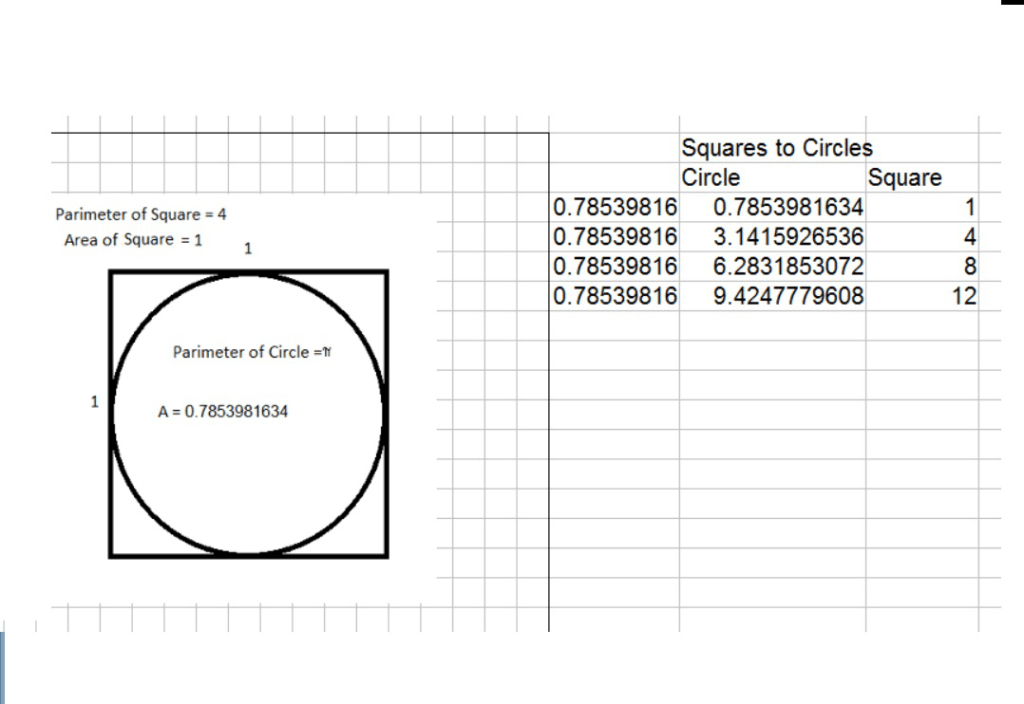
Section V:
Upon further evaluation, even with the revised formula, a perimeter of an ellipse cannot be solved, except using calculus, because the curve is not always equal to pi. I tested it on two known ellipses, and did not get a consistent result.
 B. K. Neifert